
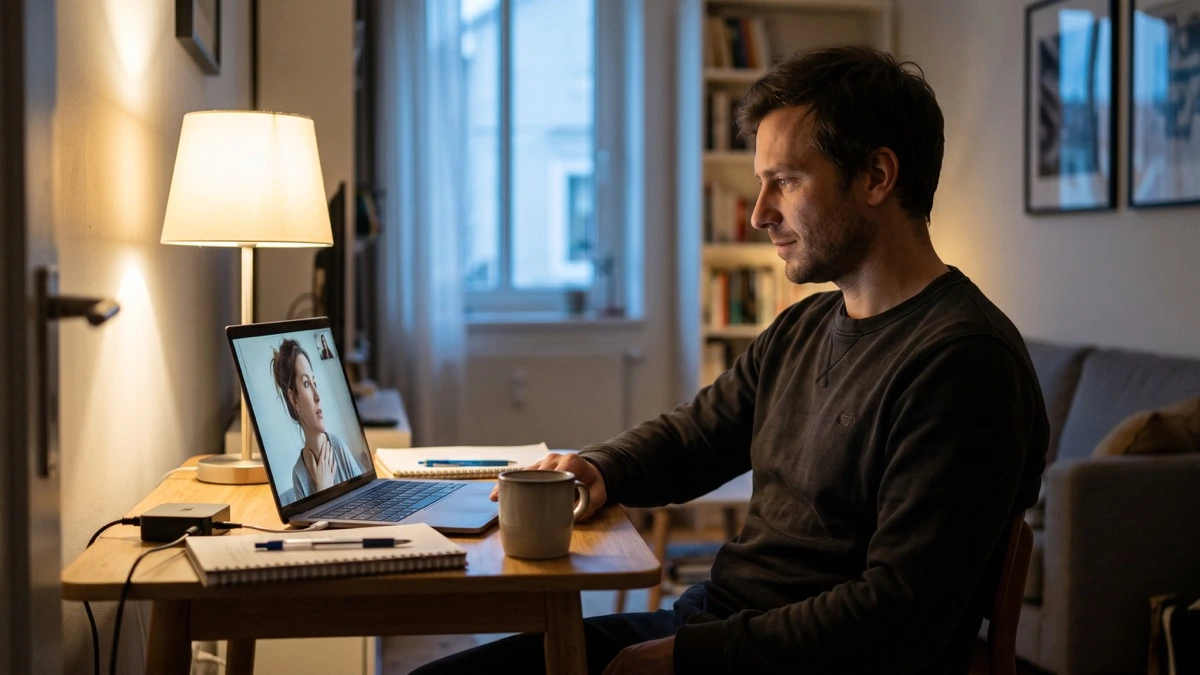
Learn how camera delay, eye contact, posture, tone, and pauses affect video chat, plus simple ways to check what a social cue means before jumping to conclusions.
Remember that the camera changes the signal
In person, eye contact happens when two people look at each other. On a call, looking at the other person means looking at the screen, while appearing to make eye contact means looking into the camera. Someone can be paying close attention and still appear to glance downward. That mismatch is built into video, not evidence of dishonesty or disinterest.
Framing removes context too. You may see a face and shoulders but miss tapping feet, a pet under the desk, or someone reaching for a charger. Compression softens expressions, lighting changes how eyes look, and a narrow field of view can make ordinary movement seem abrupt. Treat the picture as partial information, not a complete reading of the room.
Check for delay before assigning meaning to a pause
Video calls create tiny timing errors. A reply may arrive late, two people may start at once, or a frozen frame may hold an expression longer than it existed. When a reaction feels unexpectedly flat or delayed, wait a beat. Filling every silence can cause the other person to abandon a response they were about to give.
Technical trouble usually appears in clusters: lips and sound separate, several answers arrive late, or the picture freezes while audio continues. Name the problem plainly. “I think there is a little delay” is more useful than deciding the other person is ignoring you. If needed, use the room text chat for one sentence while the connection settles.
- Wait one extra second after asking a question.
- Look for repeated lag before treating one pause as meaningful.
- Say when your own audio or video is unstable.
- Avoid asking “Are you bored?” based on a single delayed response.
Read patterns instead of isolated gestures
One crossed arm, glance away, or short answer can mean almost anything. A pattern is more useful. Someone who responds to details, asks questions back, and returns their attention after a distraction is probably participating even if their posture is reserved. Someone who repeatedly gives minimal answers, looks occupied, and never takes up an opening may be ready to leave.
Tone and words deserve at least as much weight as posture. Some people naturally speak softly, show little expression, or avoid sustained eye contact. Personality, culture, tiredness, and disability all affect visible behavior. The goal is not to diagnose the person on screen. It is to notice whether the conversation feels mutual and respectful over time.
Check your interpretation with a low-pressure question
If you are unsure, ask about the immediate situation instead of the person's character. “Did my audio cut out?” is better than “Why are you not listening?” “Want to stay with this topic or switch?” gives an easy choice without demanding an emotional explanation.
Keep the check proportional. A small pause needs a small question, not a serious conversation about the relationship. The other person may say they are thinking, distracted, tired, or simply quiet. Take the answer at face value unless their behavior clearly crosses a boundary. You are gathering context, not conducting an interrogation.
- Did that question come through clearly?
- Do you want a second to think?
- Should we try a different topic?
- Is the connection okay on your side?
Make your own signals easier to read
You can reduce uncertainty by narrating small interruptions. Say “I am plugging in my charger” before you lean out of frame, or “I am thinking” when you need a moment. Brief explanations keep ordinary actions from looking like sudden withdrawal.
Use visible listening cues that feel natural to you: a nod, a short acknowledgment, or a follow-up that refers to what was just said. You do not need to perform constant enthusiasm. Clear, modest feedback is more believable and less tiring than exaggerated reactions designed for the camera.
Trust clear boundaries more than ambiguous cues
Not every uncertainty needs to be solved. If someone says no, asks to change the subject, or stops responding to a personal question, treat that boundary as clear even if they are smiling. If you feel uncomfortable, you also do not need enough evidence to prove why. You can end the conversation with Next or Stop.
Reading social cues is useful when it helps two people share the conversation. It becomes unhelpful when it turns into mind reading. Notice patterns, check simple uncertainties, and leave room for different communication styles. A good video chat does not require perfect interpretation; it requires enough patience to avoid pretending that a pixelated moment tells the whole story.
Quick answers
Frequently asked questions
Why does eye contact feel different on video chat?
Looking at someone on the screen places your gaze below or beside the camera. This built-in mismatch can make attentive people appear to look away.
Does a long pause mean someone is not interested?
Not necessarily. They may be thinking, dealing with connection delay, or choosing words. Look for a repeated pattern and ask a simple clarifying question.
How can I tell whether a video chat is going well?
Look for mutual participation over time: relevant replies, some curiosity in both directions, respected boundaries, and a rhythm that does not depend on one person doing all the work.